
Marubeni Group’s
Nature-Related Issues
We summarized the nature-related issues in the Marubeni Group's business that emerged through the Green Portal. The Marubeni Group views these nature-related issues as growth opportunities.
Dependencies and Impacts on Nature
for the Marubeni Group and Its Upstream
and Downstream Value Chain
The Marubeni Group deals with over 100 types of products and more than 500 products × VC combinations. We operate a wide range of businesses globally, which is a characteristic of the Marubeni Group.
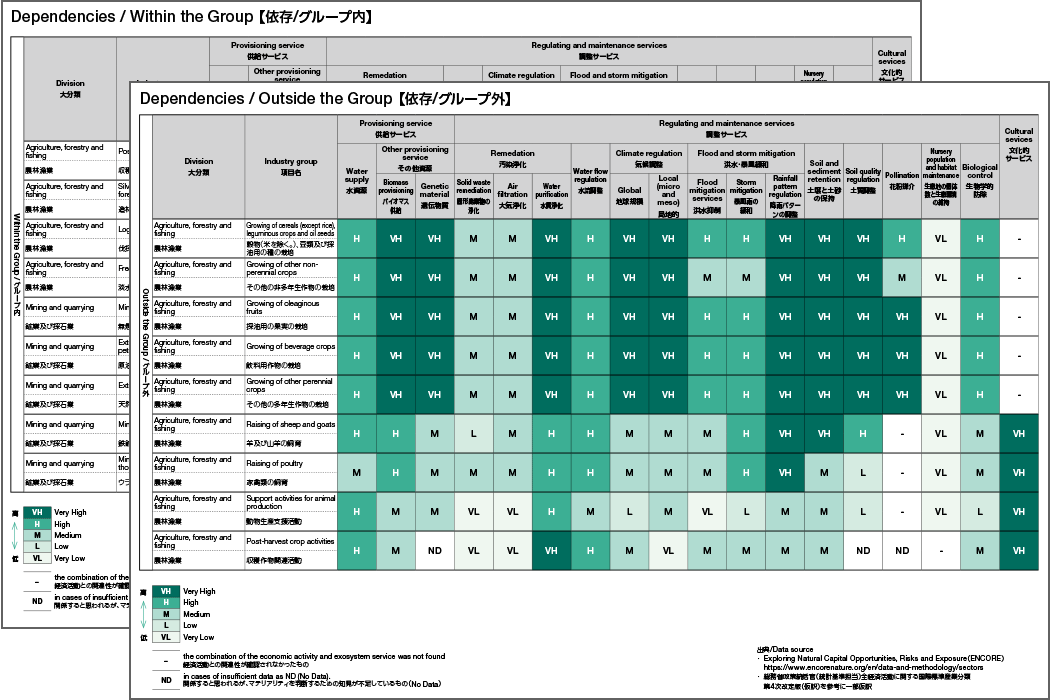
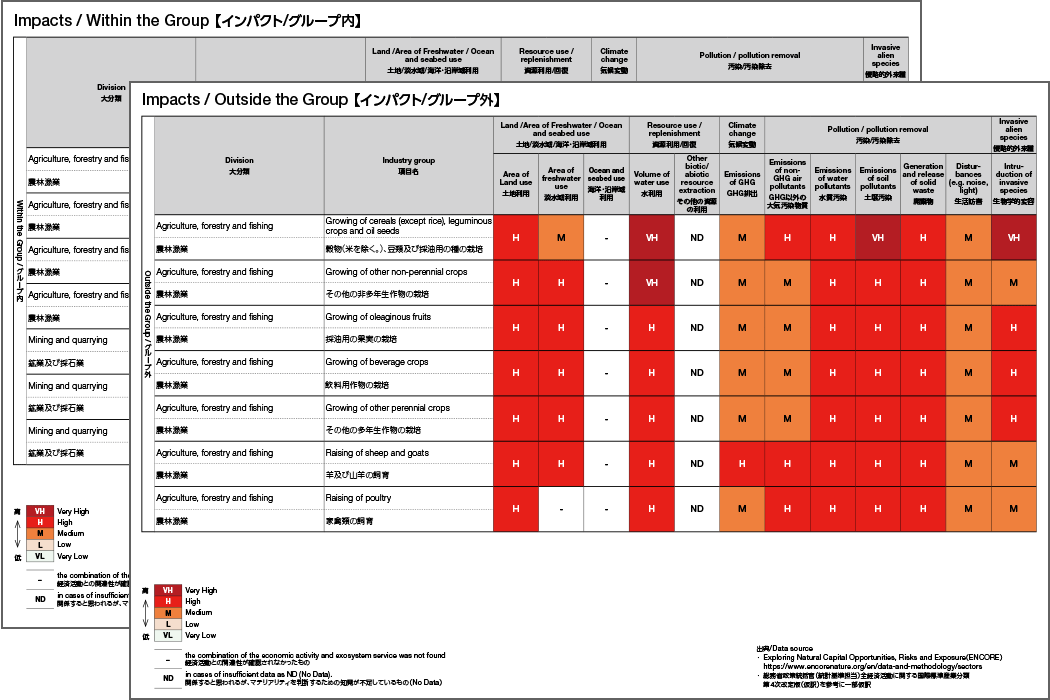
By linking the identified products × VC to the International Standard Industrial Classification (ISIC) codes and confirming dependencies and impacts for each ISIC code with ENCORE, we were able to use it as a reference to determine how the dependencies and impacts of the businesses being pursued by the Marubeni Group are generally assessed.
In the dependency and impact assessment through ENCORE, as a characteristic of connections between the Marubeni Group and upstream/downstream value chain businesses and nature, the degree of dependency and impact tends to be higher outside the Group than within it. Businesses outside the Group span a wide variety of sectors. Providing solutions to these business entities to reduce their nature-related dependencies and impacts not only contributes significantly to nature positive but also represents an opportunity for our Group to transition toward nature positive practices.
The Marubeni Group believes that nature-related issues associated with its business represent growth potential. We will drive green initiatives to take the dependencies and impacts both within and outside of our Group identified through the LEAP Approach and connect them to the Group’s growth. In addition, please refer to Marubeni’s Growth, in which we feature examples of green initiatives that connect risks and opportunities to “growth.”
For nature-related issues of the Marubeni Group, please also refer to the “Disclosure in Line with the Recommendations of the TNFD”.

Please refer to the following Heat Map which presents the assessment results for nature-related dependencies and impacts in the Marubeni Group’s products × VC.
(The heat map is based on information from ENCORE as of December 2024, which is also used for our TNFD disclosures.)
Sensitive Locations in the locations
where the Marubeni Group conducts business
We selected locations where require ecological attention (sensitive locations). These sensitive locations were identified based on the four areas: “Areas important for biodiversity,” “Areas of high ecosystem integrity,” “Areas of importance for ecosystem service provision,” and “Areas of high physical water risks.” The selected sensitive locations were organized as within or outside of the Group based on the information of products x VC.
For products × VC corresponding to sensitive locations, the next step involves verifying the actual ecological impacts at the locations where the Marubeni Group operates the business, based on each of the four relevant areas; necessary measures will be considered as needed.
Based on the findings so far, regarding direct operations, we have determined that the dependencies and impacts of the industrial afforestation business (Lifestyle Division), which deals with paper and pulp as its products, are material. In particular, Indonesia have been identified as a sensitive location and we conducted an in-depth LEAP analysis targeting the industrial afforestation in Indonesia. For details, please refer to Disclosure in Line with the Recommendations of the TNFD.
| Area | Criteria | Countries with Sensitive Locations |
|---|---|---|
| Biodiversity Importance | Areas protected for natural or ecological reasons |
|
| Areas important for endangered species |
|
|
| Ecosystem Integrity | High integrity locations |
|
| Areas of rapid decline in integrity |
|
|
| Ecosystem Service Delivery Importance | Areas important for delivery of ecosystem service benefits, including to indigenous peoples and local communities |
|
| Water Physical Risk | Areas with low water availability |
|
| Areas of high flood risks |
|
|
| Areas concerned about declining water quality |
|