
Relationship Between Business/
Economic Activities and Nature
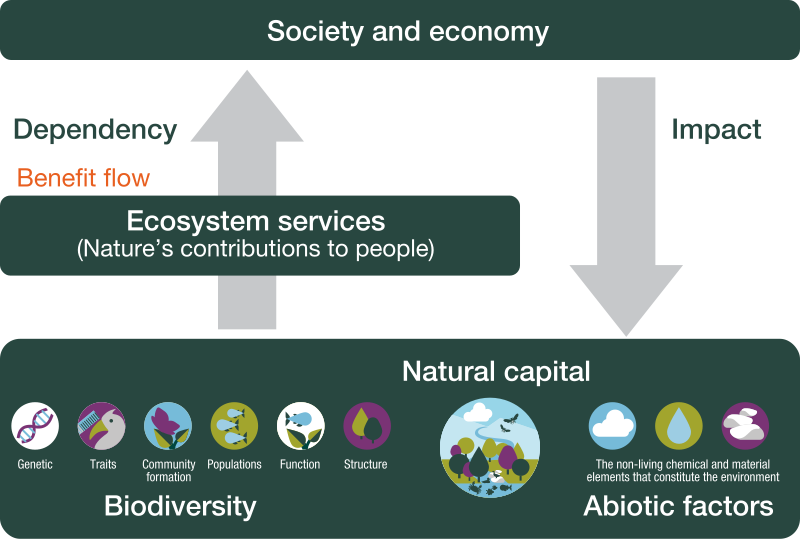
Ecosystems and the natural capital supplied by the biosphere serve as the indispensable components that underpin social activity. Human life and economic systems rely extensively on the many services that nature provides, and without them, sustainable development could not occur. This section outlines the ways in which business and economic activities draw on natural capital and impact it.
Natural capital signifies the stock of natural assets that supports human life and economic activity, encompassing biological resources as well as non-living resources, such as soil, minerals, water, gas and sunlight. The advantages that natural capital offers are wide range, including provisioning services, such as food, water and timber; regulating and sustaining services, such as climate control and water purification; and cultural services that deliver spiritual enrichment and recreational value. These advantages are referred to as ecosystem services or nature's contributions to people (NCP), and society and the economy rely on these benefits.
The Dasgupta Review, authored by an economist Partha Dasgupta, referenced studies estimating that ecosystem services worldwide provide an economic value of roughly US$125 trillion per year, which is 1.5 times that of the global GDP. Additionally, natural capital is assumed to support roughly half of the global GDP, approximately US$44 trillion, which highlights its essential role in social activities. Businesses depend on nature, and industries such as agriculture, forestry, fisheries, mining and quarrying, and manufacturing exhibit particularly strong reliance. For instance, industrial afforestation depends on the timber resources, water resource availability, the soil conditions required for healthy tree growth, rainfall patterns and the regulation of climate factors, such as temperature and humidity. The health of ecosystem services can directly influence a company’s productivity and profitability.
Meanwhile, human societies rely on natural capital and exert substantial effects on nature through their activities. Using industrial afforestation as an example, uncontrolled logging and unsustainable practices result in numerous adverse outcomes, including weakened forest ecosystems, reduced biodiversity, increased soil erosion and declining water resources. The deterioration and loss of ecosystem services that arise from these adverse effects ultimately undermine the long-term viability of forestry and other industries. According to the United Nations Environment Programme (UNEP), an estimated US$7 trillion per year, an amount equal to roughly 7% of the global GDP, in combined public and private funding flows each year into activities that directly damage nature, including deforestation and the expanded use of fossil fuels. The harmful effects of economic activity on nature disrupt ecosystem balance and endanger the ecosystem services on which people rely.

- Source:
-
- Dasgupta, P. (2021), The Economics of Biodiversity: The Dasgupta Review (London: HM Treasury), modified by MS&AD InterRisk Research & Consulting, Inc. (Open Government License v3.0).