
Earth’s Material Cycles
Across the Earth, a variety of material cycles take place in many different locations. These cycles are the source of “nature’s contributions to people” and are essential for understanding the relationships between nature and society and the economy. Here, we outline three such material cycles—atmospheric circulation, water cycle, and carbon cycle.
Atmospheric Circulation
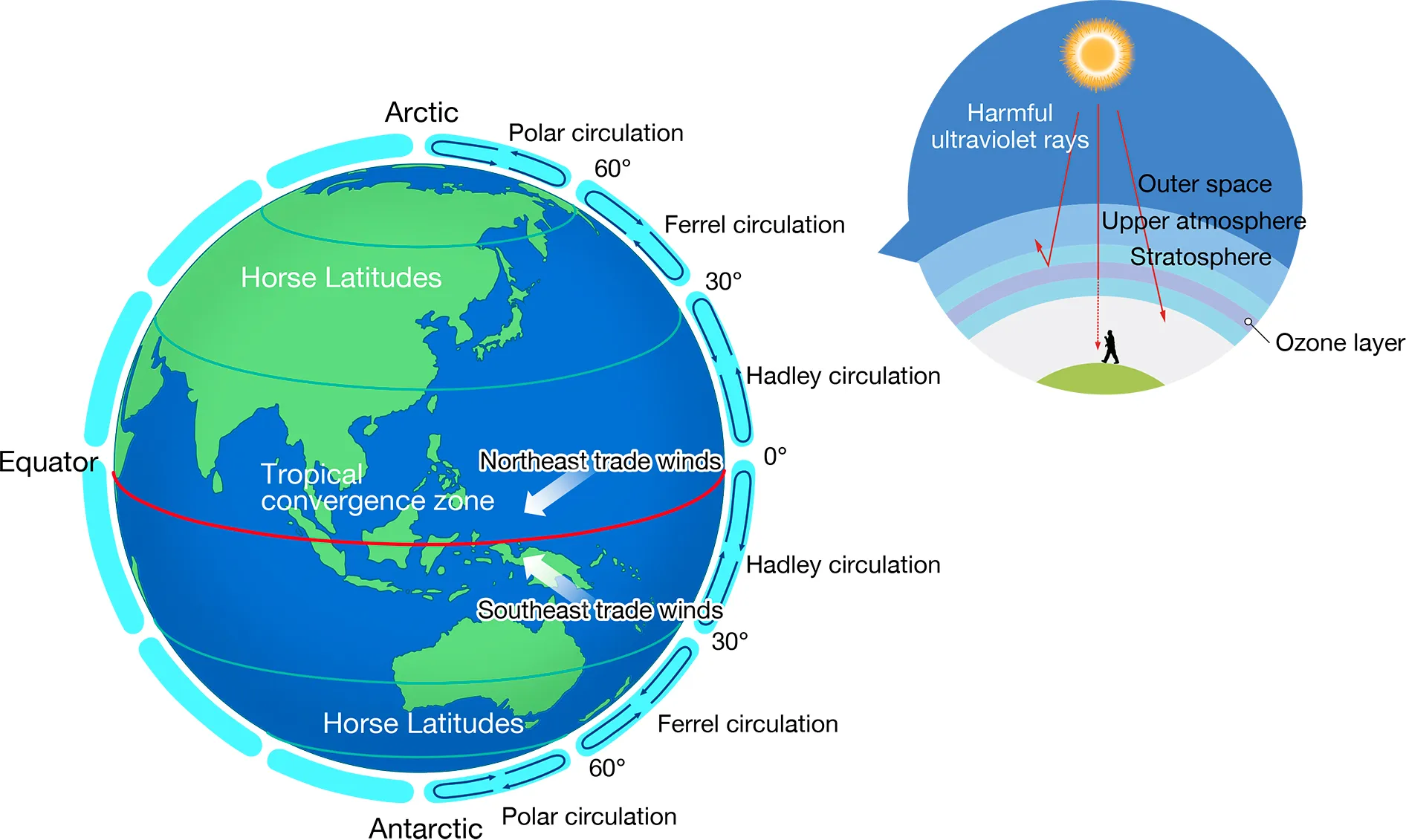
Air is always in motion within the Earth’s atmosphere. This motion results from temperature differences in the atmosphere, and it is known as atmospheric circulation because it operates on a planetary scale. “Atmospheric circulation” can be divided into three major components.
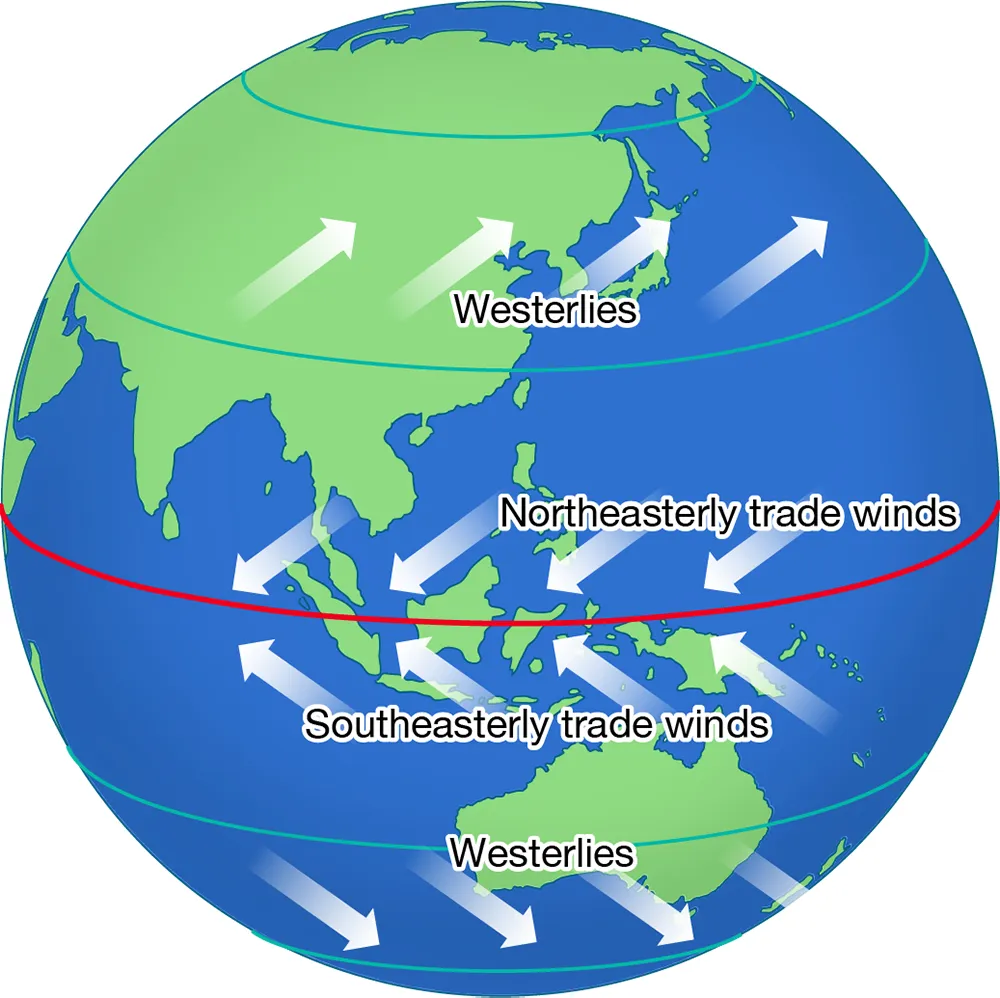
The first component is the Hadley circulation, which occurs in low-latitude regions. Temperatures on the Earth are higher at low latitudes—near the equator—and lower at high latitudes—near the North and South Poles. When air warms, its density drops, making it lighter than the surrounding air and causing it to rise. Consequently, warm air continuously ascends in the equatorial low latitudes. After rising, the air moves toward the north and south in the upper atmosphere, and as it cools, it becomes heavier and descends, flowing along the surface before eventually returning to the equator. The air returning to the equator warms again, rises once more, and continues this cycle, producing atmospheric circulation in low latitudes. The Earth’s rotation also generates a force that causes a force to act to the right of the direction of movement of an object (Coriolis force). This causes surface winds to flow toward the equator to take on an easterly direction. These winds are called "trade wind," and it is one of the winds that blow constantly. During the age of sailing ships, trade winds played an important role in transportation. As trade winds blow near the ocean surface, they also drive large-scale seawater movement and help shape ocean currents. The strength of the trade winds influences events such as El Niño and La Niña, making them winds that strongly affect Japan’s climate.
At high latitudes near the Arctic and Antarctic, a type of circulation known as the polar circulation operates. Like the Hadley circulation, the polar circulation causes cold air from the poles to flow toward the mid-latitudes. The air is warmed in the relatively warm mid-latitudes, rises, and then travels poleward in the upper atmosphere, completing a closed circulation loop.
Between the low and high latitude lies the mid-latitude region, where the Ferrel circulation occurs. The Ferrel circulation does not function as direct circulation in the way the Hadley and polar circulations do but form indirectly through their interactions. When descending air from the Hadley circulation moves near the surface, some of it flows toward the higher latitudes rather than toward the equator. This poleward-moving air rises when it encounters surface winds driven by the polar circulation. Subsequently, it travels equatorward in the upper atmosphere, completing a closed circulation loop. Westerly winds, including the jet stream, are especially prominent in the mid-latitudes. Westerly winds are powerful winds that blow from the west to east at high altitudes, and it's the reason why flight times differ between eastbound and westbound travel. Aircraft traveling east can use these winds to shorten travel time, while those flying west encounter headwinds that increase flight time and fuel use. As westerly winds also carry yellow sand to regions around Japan in the spring, they are a familiar part of daily life.
All three of these circulation systems occur along the meridian plane, which cuts across the Earth from north to south. Meridional circulation transports large amounts of heat and water vapor and is crucial in the development of tropical cyclones (typhoons) and fronts. As climate change raises global temperatures, the atmosphere holds more water vapor, which is believed to contribute to the increasing frequency of heavy rainfall.
- Source:
-
- Jet Propulsion Laboratory “Climatic Zones,” modified by Marubeni
- Source:
-
- Japan Maritime Public Relations Center, modified by Marubeni
Water Circulation
Nearly 70% of the Earth’s surface is covered by water, which is why it is often called “the water planet.” Of all the planets in the solar system, Earth alone has an abundance of liquid water, which is believed to have played a crucial role in the origin of life. Water is never fixed in one location, continually shifting between different states and circulating throughout the hydrosphere.
As an example, when the sun’s thermal energy causes seawater to evaporate, that water enters the atmosphere in the form of water vapor. This water vapor then forms clouds overhead and later returns to the surface as precipitation, such as rain or snow. This water vapor forms clouds in the sky and eventually falls to the ground as rain (or snow). The rain that falls on the ground forms rivers and groundwater, and eventually flows into the sea, which is a representative example of the cycle. In the actual water cycle, some water evaporates from plants or seeps into the ground as groundwater, so it can be said that water circulates in a very complex and diverse manner. For instance, Japan is assumed to receive roughly 600 billion tons of precipitation each year, of which approximately 100 billion tons flow directly from rivers to the sea during rainfall events, around 200 billion tons are returned to the atmosphere through evapotranspiration by plants, and the remaining portion infiltrates the subsurface and becomes groundwater. Certain portions of this groundwater emerge as springs and feed rivers that flow continuously.
Furthermore, salt is removed from seawater during the water cycle. Therefore, the freshwater resources available to humans and other living organisms can be regarded as being sustained by this cycle. Simultaneously, the freshwater we use in everyday life is itself a component of the water cycle. Thus, preserving a healthy water cycle is vital for achieving a sustainable society. In recent years, the water cycle has been increasingly threatened by factors such as changes in land use and population growth, and measures that protect the water cycle by properly managing forests, rice paddies, and farmland and allow rainwater to infiltrate the soil are drawing increasing attention.
Water appears in different forms (liquid water, water vapor, and ice) throughout the water cycle, and in each state, it transports various substances, including nutrients, soil, and heat. As an example, rivers transport nutrients, such as calcium and silica, to the ocean, forming the foundation that supports photosynthesis in marine phytoplankton. For additional details on the role of water on Earth, please refer to “Components of Nature.”

- Source:

- Source:
-
- Geosphere Environmental Technology Corp. “The Global Water Cycle and Water Issues,” modified by Marubeni
Carbon Circulation
Carbon is present throughout the Earth. It appears in many forms, ranging from elemental carbon, like graphite (used in pencil lead) and diamonds, to compounds formed with elements such as nitrogen and oxygen. Most of the carbon on the Earth is assumed to exist in compound form, and carbon is contained in sugars, proteins, and amino acids, which are vital for life.
Carbon circulates around the planet in a manner similar to air and water. Plants, for instance, rely on sunlight to produce organic matter from water and carbon dioxide. This process, known as photosynthesis, transforms carbon in the atmosphere, present as carbon dioxide, into a form that living organisms can use. The organic matter (carbon) fixed by plants becomes food for insects and herbivores, and when carnivores consume these animals, the carbon is transferred again to other organisms, and so on. Hence, carbon moves continually through the food chain. The feces, bodies, and dead plant material of organisms are broken down by microorganisms. Through this decomposition, carbon is ultimately released back into the atmosphere as carbon dioxide. Thus, carbon fixed via photosynthesis circulates through ecosystems as organic matter and ultimately returns to the atmosphere. Over extremely long timescales, some of the surviving organic matter become fossil fuels, such as coal and oil. All the fossil fuels used today originate from ancient organisms, and the tens of millions of years needed for biological remains to form fossil fuels result in the carbon released from their combustion being regarded as one-way emissions rather than part of a cycle.
The carbon cycle occurs not only on land but also within the oceans. The marine carbon cycle is broadly divided into the “solubility pump” and the “biological pump.”
The term “solubility pump” refers to the mechanism by which carbon dioxide from the atmosphere dissolves into seawater. Carbon dioxide dissolves readily in cold seawater, and the ocean is said to hold roughly 50 times more dissolved carbon dioxide than the atmosphere. In the early atmosphere that existed when Earth first formed, volcanic activity released carbon dioxide and water vapor as the main gases. As the planet cooled and the oceans formed, carbon dioxide dissolved in the seawater, causing its atmospheric concentration to fall significantly. Incidentally, some of this carbon dioxide combined with calcium ions and settled on the seafloor as limestone.
The “biological pump,” which is another oceanic carbon cycle pathway, resembles the terrestrial carbon cycle. In the ocean, carbon is fixed through photosynthesis by phytoplankton and seaweed or seagrass. This organic matter then moves through the ecosystem by being consumed by zooplankton, fish, crustaceans, and marine mammals. Their feces and carcasses decompose, and part of the carbon eventually returns to the atmosphere.
Carbon is also transported through the weathering of rocks on land and in the ocean. During this process, natural rocks, such as basalt, break down gradually, absorbing carbon dioxide and storing it in the form of carbonates. Recent research has explored “negative emission technology,” which aims to utilize this carbon-absorbing and carbon-fixing mechanism associated with rock weathering as a means of capturing and storing atmospheric carbon.
The natural carbon cycle remains highly balanced, but one-sided carbon emissions from human activities are disturbing this balance. Climate change, which has contributed to unprecedented heatwaves and increasingly severe natural disasters in recent years, is believed to stem mainly from rising atmospheric carbon (carbon dioxide). Shifts in temperature and the climate could influence atmospheric circulation and the water cycle, creating an urgent need to move away from fossil-fuel-dependent social systems.
Biofuels made from plants (such as corn and sugarcane) are available as an alternative to fossil fuels. Although biofuels release carbon dioxide when burned, this process simply returns to the atmosphere the carbon dioxide previously absorbed during plant growth. Therefore, carbon dioxide emissions and absorption are considered balanced (zero). Some argue that biofuels are not perfectly carbon neutral, but they are considered to utilize the carbon cycle, especially when compared with the one-way release of carbon from fossil fuels. For additional details, please refer to “Material Transport Associated with Social and Economic Activities.”

- Source:
-
- NTT Corporation, Space Environment and Energy Laboratories, modified by Marubeni